My article in Bronte Studies

My article in Bronte Studies
My article

Monday, 26 August 2024

Over 100,000 blog visits

 My objective was always for tell the story of William Smith Williams. 

His relationship with Charlotte Brontë is well known, but nonetheless fascinating. 

He wrote about painting and was expert in lithography. 

He published John Ruskin’s later works on political economy. 

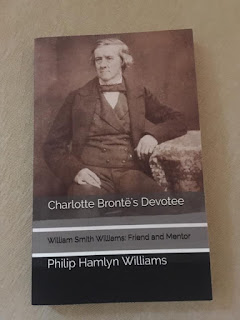
Here is something more about my book Charlotte Brontë’s Devotee

Monday, 6 May 2024

Sir Arthur Lowes Dickinson - son in law of William Smith Williams


Arthur Lowes Dickinson was educated at  Charterhouse from where hr went to King’s College, Cambridge. Arthur gained a first in Maths. 

He became an accountant, soon becoming a partner in the London firm of Lovelock, HWS Whiffin & Dickinson. Through an involvement with a Californian company, he came to know Nicholas Waterhouse, son of one of the founders of Price Waterhouse. At that time, the American firm associated with Price Waterhouse was thriving but had lost both of its lead partners. Waterhouse asked Dickinson to go to New York to take charge. 

Arthur sailed on 1 April and took up his post on I July. He would serve the American firm until 1909 when he declared his wish to return to London. The death of his father in that year may have had some influence on this. In his eight years, the firm achieved prodigious growth, opening offices in San Francisco, Mexico City, Seattle, Montreal, Boston and Toronto. He also played a major role in the US accounting profession. All this came at a cost of a breakdown in his health. Sir Nicholas Waterhouse described him as ‘a man of terrific and unbounded energy’ and as having ‘the kindest and most sympathetic disposition. ’ 

Like a number of partners in Price Waterhouse, in 1915 Arthur volunteered to the war effort and served the Ministry of Munitions as financial adviser to the controlled establishment division. This division managed the factories around the country which had devoted production to the war effort.   Arthur, together with five other Price Waterhouse partners were awarded knighthoods for their war work. 

Arthur was married to Ellen Smith Williams, eldest daughter of William Smith Williams who discovered Charlotte Bronte. He was son of the celebrated artist Lowes Dickinson and brother of Goldsworthy Lowes Dickinson one of the thinkers behind the League of Nations.


Sunday, 21 August 2022

Charlotte Bronte and the Great Exhibition of 1851

 A Great Exhibition at the Crystal Palace, celebrating industrial advances, had been promoted from July 1949 by Prince Albert and Sir Henry Cole, the same man who had encouraged William Smith Williams in his paper on lithography. It went through many and long arguments. Some people, such as Ruskin, had serious reservations about the benefit of industry. Others were writing about its very clear disadvantages in terms of urban poverty. All strands of industry from both Great Britain and elsewhere were to exhibit their wares. In the early part of 1851 Richard Williams, William’s brother, was acting as Secretary to the group of Surgical Instrument makers preparing their displays for the Great Exhibition. He was running the office of Weiss & Co at 62 The Strand. For the exhibition, Weiss had produced a most marvellous instrument comprising 1,851 knives. This was clearly a bit of showing off. Yet, behind the scenes, advances were being made in surgery with the work of Lister and others and the makers of instruments took up the challenge to keep pace. 

Charlotte Brontë’s relationship with the Exhibition was perhaps characteristic. On 17 April 1851 she wrote to George Smith’s mother to say, ‘I was nursing a comfortable and complacent conviction that I had quite made up my mind not to go to London this year: the Great Exhibition was nothing – only a series of bazaars under a magnified hothouse.’   She did though go, as she wrote to her father on 31 May 1851

Yesterday we went to the Crystal Palace – the exterior has a strange and elegant but somewhat unsubstantial effect – The interior is like a mighty Vanity Fair  - the brightest colours blaze on all sides – and ware of all kinds – from diamonds to spinning jennies and Printing Presses are there to be seen – It was very fine – gorgeous – animated – bewildering… 

The Great Exhibition drew both great praise and harsh criticism. A wonderful series of lithographs were produced by Lowes Dickinson’s firm and this is available for us to see on the British Library website. Lowes Dickinson later married William Smith Williams's eldest daughter.

The blade cross produced by Weiss whose image this is.

I explored the catalogue of the Great Exhibition for my book How Britain Shaped the Manufacturing World published by and available from Pen & Sword.


Sunday, 22 May 2022

William's brother - the manufacturer

Richard, William's brother, exhibited at the Great Exhibition of 1851. He managed the business of Weiss & Son at 62 The Strand, just over the road from where he was born.

Weiss made surgical instruments. Lindsey FitzHarris has written a fascinating book on 19th surgery entitled The Butchering Art, and I draw on this to paint a picture of the world Richard Williams sought to serve. When he started out, surgery was largely a matter of dexterity. There were no anaesthetics, and so speed in operation was of the essence. There were no antiseptics and experience had also taught surgeons that the only operations, where the patient had any real chance of survival, were those as least invasive as possible, and, even then, the patient was more likely to die than live. Richard would have witnessed the opening of the Charing Cross Hospital, not far from Weiss’s premises. He may have witnessed operations, which were often public spectacles with a great deal of blood and gore. He would have been aware of the great strides made in anaesthetics in the 1840s in Edinburgh which saved patients the agony of experiencing the knife. It was a world that was progressing on many fronts and only a few years later antiseptics would begin to be used. 

I have looked through the catalogue of the Great Exhibition to write my latest book, How Britain Shaped the Manufacturing World. It is to be published by Pen & Sword in June 2022. 

Bronte lovers will know what Charlotte thought of the Great Exhibition, as she wrote to her father on 31 May 1851:

‘Yesterday we went to the Crystal Palace – the exterior has a strange and elegant but somewhat unsubstantial effect – The interior is like a mighty Vanity Fair  - the brightest colours blaze on all sides – and wares of all kinds – from diamonds to spinning jennies and Printing Presses are there to be seen – It was very fine – gorgeous – animated – bewildering…'


Sunday, 27 February 2022

Charlotte Bronte's Devotee - by chapter

Childhood 

I explore William Smith Williams's family background, which I share, and then what we know of his childhood above his father's business on London's strand

Apprenticeship

William's father and mother had died before his was fourteen, but his father provided for an apprenticeship for him and his brother, my great grandfather. William was apprenticed to a small publishing house who published Keats among others. William was clearly much impressed by Keats for one of the few pieces of his writing is poem in praise of the poet. He made lifelong friends with 

Hullmandel Years

On completing his apprenticeship, William went to work for the pioneering Lithographer, Charles Hullmandel in London's Soho. He clearly gained a deep understanding of the technique but also the artists who used it, for another of his surviving pieces of writing is a remarkable paper he presented to the Society of Arts in 1847. William also wrote on art and theatre for a number of magazines. I quote examples of his writing.

The House of Smith, Elder

William was to move from Hullmandel to another publishing house and I tell of its history. 

The Bronte Years – Jane Eyre

William is best known as the Reader at Smith, Elder who recognised the potential Charlotte Bronte showed in The Professor and then the genius in Jane Eyre.

The Bronte Years - Friendship

William and Charlotte became friends, as is clear from letters she wrote to him and which he kept. Sadly his letters to Charlotte have not been discovered. Much of the correspondence concerns William's concerns about his daughters. I write of William's modern attitude to women. The family lived in Kensington with George Lewis as their neighbour. Lewes would become the lifelong companion of George Eliot.

The Bronte Years – Art and Tragedy

William's passion for art is shared with Charlotte but she suffers the tragedy of the death of her siblings.

The Bronte Years – Cornhill Parcels

Charlotte is conscious that her knowledge of the world falls short of many of her contemporary authors. William seeks to address this by sending parcels of carefully chosen books, in effect a course in humanities.

The Bronte Years - Cooling

Charlotte's books, Shirley and Villette are published but the correspondence between Charlotte and William display a cooling in their relationship which comes to an end with Charlotte's marriage and, of course, then her death.

The Cornhill

A new challenge for William is in support of Thackeray as editor of the Cornhill Magazine, Smith Elder's answer to the periodicals being published by competitors.

The Ruskin Years

William had quite probably met John Ruskin when he worked for Hullmandel. Smith, Elder had published Ruskin's works on art and architecture. William takes up the Ruskin relationship when the latter turned his skills to political economy. I explore these books and William's contributions.

Home Life

William retired months before his death at age 75. I write of his family relationships and his final publishing project for his friend from their early twenties, poet Charles Wells.


You can buy Charlotte Bronte's Devotee in paper back or on Kindle


Sunday, 5 December 2021

I’m thrilled that you are finding this blog helpful

 I have been reading some of the comments left on this blog. I am thrilled that people are finding my research of some use. I thoroughly enjoyed discovering the life of my great great uncle. 

You can find more in the article in Brontë Studies and, of course, in the book Charlotte Brontë’s Devotee. 


Friday, 12 March 2021

William Smith Williams, Charlotte Bronte and Kensington

William Smith Williams' family moved to 3 Campden Hill Terrace (now 98 Campden Hill Road), Kensington in 1844. Critic, George Henry Lewes, was their neighbour and a friendship grew between the two families and that of Thornton Hunt, the son of the writer, Leigh Hunt. Lewes would later become the long term partner of George Eliot. The writer, Julia Kavanagh, lodged with the Williams at the house on Campden Hill. I explore more about William's relationships with Lewes, Hunt and Kavanagh in my book.

In July 1848, Charlotte and Anne Bronte visited the Williams family at Campden Hill. Charlotte writes:

[We] then went home with Mr Williams to tea - a saw his comparatively humble but neat residence and his fine family of eight children - his wife was ill. A daughter of Leigh Hunts’ was there - she sung some little Italian airs which she had picked up amongst the peasantry in Tuscany. 


Wednesday, 23 December 2020

William’s brother and 19th century surgery

William Smith Williams’s elder brother was my great grandfather, Richard.

As boys they lived on London’s Strand, then a busy road in a crowded new urban area. Very nearly opposite their dwelling, above their father’s wax and tallow chandler business, were the premises of John Weiss, Surgical Instrument Makers.  

One of my treasured possessions is the signed cover of a copy of the catalogue of the Great Exhibition presented to my great-grandfather by the members of the Surgical and Anatomical Committee Class X, ‘as a slight token of the services rendered by him as Secretary’. Richard managed the business of John Weiss & Son, manufacturers of surgical instruments at 62 The Strand, and, I like to think, offered his services for the exhibition.

For the exhibition, John Weiss & Son had produced a most marvellous instrument comprising 1,851 knives. This was clearly a bit of showing off. Yet, behind the scenes, advances were being made in surgery with the work of Lister and others, and the makers of instruments were taking up the challenge to keep pace. Lindsey FitzHarris has written a fascinating book on 19th surgery entitled The Butchering Art, and I draw on this to paint a picture of the world Richard Williams sought to serve. When he started out, surgery was largely a matter of dexterity. There were no anaesthetics, and so speed in operation was of the essence. There were no antiseptics and experience had also taught surgeons that the only operations, where the patient had any real chance of survival, were those as least invasive as possible, and, even then, the patient was more likely to die than live. Richard would have witnessed the opening of the Charing Cross Hospital, not far from Weiss’s premises. He may have witnessed operations, which were often public spectacles with a great deal of blood and gore. He would have been aware of the great strides made in anaesthetics in the 1840s in Edinburgh which saved patients the agony of experiencing the knife. It was a world that was progressing on many fronts and only a few years later antiseptics would begin to be used. Weiss & Son are still in business.  I imagine Richard’s son, Alfred my grandfather at age nineteen, visiting the exhibition and being inspired by all he saw. He would go on to register a number of patents during his varied career including that for a life raft for which he won a number of awards. It was an age of invention.


Richard Williams


Wednesday, 21 October 2020

Charlotte Brontë’s Devotee by his great great nephew Philip Hamlyn Williams - Lincoln Civic Trust

“The mysterious publisher William Smith Williams has always been the unsung hero of the Brontë Story. Not only did he discover Jane Eyre, he was Charlotte Brontë’s friend and supporter. In a fascinating book Smith Williams is at last brought to life thanks to the forensic skills of his great, great nephew.” 

Biographer, Rebecca Fraser, kindly wrote this on reading the draft of the book I had been working on for the last fourteen years and on which I had the pleasure of speak to the open meeting of the Civic Trust on 29 November 2019.

The book tells story of Charlotte Brontë’s relationship with William Smith Williams who, as the Reader at her publisher Smith, Elder & Co, recognised her genius. But, who was he? William was a radical Victorian, friend to many of the giants of 19th century art and literature: Thackeray, Thomas Carlyle, Elizabeth Gaskell, George Eliot and the Rossettis. Through him we gain an insight into the world of publishing, the art and science of lithography and the controversial thinking of John Ruskin on women’s education, politics and economics. He was a family man and, with his wife Margaret, produced a line of remarkable progeny.

Whence had he come and wither did he go? Charles Dickens and George Meredith were also publishers’ Readers and their stories are well known, but what of William Smith Williams?

I found a true Renaissance man as at home with art as with literature, with science as with politics. His childhood had been spent in the crowded courts bordering London’s Strand. He was orphaned at age fourteen and then largely self educated. He was an apprentice publisher and then a lithographer before joining Smith, Elder. He wrote a poem in praise of John Keats and presented a paper to the Society of Arts on Lithography. Following his all too few years of friendship with Charlotte Bronte, he mentored many other writers. One such, Frederick Wicks, wrote this if him:

‘Thrusting back his massive growth of white hair, he would clasp his hands nervously in thought before delivering his opinion, and then would follow in short, pregnant sentences a perfect flood of light upon the matter in hand. He was never content with general commendation and approval, but always gave good, sound reasons and sufficient cause for all he thought. Among the many pregnant phrases that fell to my lot was one of extraordinary value as a check to the exuberance of youth. “You need,” he said, “restraint – not that which checks, but that which guides the literary faculty.”’

He edited the 1861 Selections of the Writings of John Ruskin and then supported Ruskin in the publication of his works on political economy. Of interest to the citizens of Lincoln is a letter John Ruskin wrote to the then Mayor, WT Page, on 22 January 1883 the original of which is in the Lincolnshire Archives. We all know what Ruskin said about Lincoln Cathedral; well, it is in this letter:

‘I have always held (and am prepared against all comers to maintain my holding) that the Cathedral of Lincoln is out and out the most precious piece of architecture in the British islands, and—roughly—worth any two other cathedrals we have got.’

He said rather more which may make us shudder:

‘The town of Lincoln is a lovely old English town, and I hope the Mayor and Common Council men won’t let any of it (not so much as a house corner) be pulled down to build an Institution or a Market—or a Penitentiary or a Gunpowder and Dynamite Mill—or a College—or a Gaol—or a Barracks—or any other modern luxury.’

But also set a challenge:

‘It might possibly make the upper students of the art classes look up a good many things that they would be the better for knowing, if the Town Council were to offer a prize for a design to be painted or frescoed in the Town Hall, of the most pathetic and significant scene in all British history—the first real “Union of Scotland and England”—in the funeral procession of Bishop Hugh—when the King of England (John), barefoot, bore the coffin, with three Archbishops, and the King of Scotland followed, weeping. The prize might be open to all students born between Lincoln and Holy Isle?—or better, perhaps, between Tweed and Trent?’ 

William Smith Williams was buried in Kensal Green cemetery with his wife, one son and two daughters and son in law celebrated portrait painter, Cato Lowes Dickinson under a memorial designed by AC Gill. His daughter, Anna, was a celebrated concert soprano. One grandson, Sir Arthur Lowes Dickinson, was a founding partner of Price Waterhouse in the USA, another, Goldie Lowes Dickinson, was one of the thinkers behind the League of Nations.

Charlotte Brontë’s Devotee may be found at Lindum Books on Bailgate. 

This article is reproduced from the Civic Trust annual report


Tuesday, 22 September 2020

A wonderful review of Charlotte Brontë's Devotee in Brontë Studies

I couldn't be more thrilled than to read the review of Charlotte Bronte's Devotee in the autumn edition of Brontë Studies written by its editor, Amber Adams. In her editorial piece, she refers to him as 'that splendid man William Smith Williams'.

Bronte Society Members can access the review through the members area of the website. Otherwise, it is available to read through Taylor and Francis on-line.

Here is the opening paragraph of the review:

You can buy Charlotte Brontë’s Devotee by following this link 


Friday, 24 July 2020

My William Smith Williams blog

I am so pleased that this blog continues to welcome a good number of visits each day. 
I have included in it my research into the life of William Smith Williams as it progressed over four years of exploring archives. The fruits of that research were gathered together, first, in the article I wrote for Brontë Studies, and this has been downloaded a gratifying number of times. 


There is then the book itself which has received some wonderful reviews, and is available in both paperback and Kindle editions. 
William’s home in Kensington where he and his family entertained Charlotte Brontë 

Saturday, 4 April 2020

Reduced price of Kindle edition until Easter

I have reduced the price of the Kindle edition for the period up until Easter in case there are Brontë lovers, stuck at home at the moment, who are quite interested in William Smith Williams, but not interested enough to buy the paperback at £9.95!
My purpose in writing the book was to get William’s story better known. In this, I was thrilled to have had an article accepted by Brontë Studies, which has now been downloaded over 100 times; my blog on the article has had 900 views. 

Monday, 23 March 2020

Belgravia and William

Charlotte Bronte wrote of seeing William and some of his children at a Ball. Having seen William's relatively modest house, I wondered what such an event might have been like. If you are watching Julian Fellows’ Belgravia on ITV, you may gain a sense of the social life on the fringe of which William and his family lived.

I was fascinated to find another connection with my current work in progress which, amongst much else, looks at aspects of the industrial revolution. Fellows has a character who as a young man owns a cotton mill in Manchester importing raw cotton from India. I am discovering the huge impact that the cotton industry had.
A third connection is with another of my books, MacRoberts Reply. Alexander MacRobert went as a young man in 1870 to Cawnpore in India (known as the Manchester of India) where he grew the British India Corporation with interests in all manner of textiles.

Saturday, 14 March 2020

William Smith Williams and Women

William Smith Williams was a son of the 19th century, and so we may expect to see in him attitudes from a society where women are viewed as second class. Is this though what the evidence reveals? In my writing of Charlotte Bronte’s Devotee (CBD) I came across quite a lot which sheds helpful light.

His mother died when he was aged ten, or thereabouts. He had an older brother, my great grandfather. His father was in business with a woman, Mary Nethersole the widow of the former owner of their wax and tallow chandler’s business. He had an aunt, Rebecca, but I found no evidence of contact with her. He had an extended family in Oxfordshire; certainly one maiden aunt, great-aunt Susanna, is mentioned. The truth is we know little of his childhood until he came within the embrace of the Hill family at Broxbourne.  The father, Francis Hill, was a rather austere school master and cleric. He and his wife had four daughters, one of whom, Margaret, William married and another became the wife of  William’s close friend, Charles Wells. I see the close relationship with the Hill family underscored when William and Margaret return to Broxbourne for the baptisms of their first three children. They became William’s family.

During his apprenticeship, William met John Keates and his poem about Keats, written after his death, perhaps offers ambiguity in its import. William writes ‘Mixt admiration fills my heart, not can I tell which most to love – the Poet or the Man’. (CBD p.30.) A decade later, William was in a social circle with radicals George Lewes and Thornton Hunt, and there are suggestions of a somewhat alternative way of life in the form of open marriage, certainly enjoyed by Lewes until he became the long term partner of George Eliot. (CBD p.66.)

We know most about William from the letters Charlotte Bronte wrote to him. Although she was writing as Currer Bell to disguise her gender, I believe that, from early on, William suspected that she was a woman. I infer from her letters that he treated her in every sense as an equal, unlike George Lewes whose laboured attention to her gender caused her great annoyance. (CBD p.140.) Women move to the centre stage when he writes to her about his four daughters, most particularly the profession they should follow, since he clearly does not want them to be beholden to a husband. He wants for them, independence.

There is perhaps a contrast when William thinks of his wife, and that he observes the absence of close friendship. (CBD p.139.) It may be that Margaret didn’t have close friends, or perhaps that William was too busy to notice. We do know that Margaret had strong family relationships as evidenced by letters to sisters in New Zealand. William would have experienced nothing of this kind.

We see William having professional relationships with a number of women. Mrs Lynn Linton was critical of him, perhaps for not publishing her manuscript. (CBD p.66) Elizabeth Gaskell looked to him for reassurance. (CBD p.180) He had a portrait of George Eliot on the wall of his office. (CBD p.184). In 1874 Millicent Fawcett wrote to William to ask his advice on publishing her novel, Janet Doncaster, asking whether she should publish it anonymously given her other writing on Political Economy. (CBD p.210)

Possibly the most difficult area comes with John Ruskin for whom William published his later writing on political economy and education, particularly the education of women. It is here where we confront attitudes that are so far adrift from contemporary thinking that it is difficult to get near. Having said this, Ruskin was advocating the education of women and not just for the home. (CBD p.205) It was only that it was education different to that available for men.

We can finally look at William’s legacy for evidence. (CBD ch12.) Jane Eyre shines bright at his belief in talent irrespective of gender. His youngest daughter was a celebrated and well regarded concert soprano. His eldest daughter was wife to a celebrated portrait painter Lowes Dickinson and mother to equally celebrated sons, Sir Arthur, an accountant, and Goldie one of the thinkers behind the League of Nations. For Goldie, his mother was the perfect woman. William’s two other daughters lived their adult lives as independent women, one a widow and the other divorced, but both gainfully employed.

Margaret Dickinson

Monday, 10 February 2020

Review in Brontë Gazette

I was thrilled by this review in the Brontë Gazette:
I reproduce this with permission from the Brontë Society. Patsy Stoneman is an acclaimed literary critic who specialises in 19th-century English novel. She is Reader in English at the University of Hull.
You can buy Charlotte Brontë's Devotee from The Bronte Society and on Amazon.

Wednesday, 27 November 2019

Review of Mother of the Brontës by Sharon Wright

Sharon Wright’s Mother of the Brontës is a book as sensitive as it is thorough.

It is, in truth, a love story, and, as with so many true love stories, the end is desperately sad. In arriving at this point, though, Sharon weaves a most engaging tale, drawing on Maria’s wonderful letters. I found myself laughing at them, as I read about half forgotten feelings in romance conducted by letter. She paints a lively picture of 18th century Penzance for the well to do. Her images of early 19th century travel are as vivid, as they are uncomfortable. Her Yorkshire is cold and grey, with the occasional break in the cloud to reveal Maria's wonderful social grace.

Having read it, I can much better understand Charlotte, scarred as she was by witnessing so much pain and sadness at such a young age. I can also sympathise more with Patrick. It is a ‘must’ for Bronte fans.

Wednesday, 25 September 2019

Reviews of Charlotte Bronte's Devotee

Amber Adams, editor of Brontë Studies wrote a lovely review in the October 2020 edition volume 45 issue 4. You can read it by following this link, or by accessing through the members area of the Bronte Society website. 

Sharon Wright writes on Twitter:

I enjoyed this illuminating biography of Charlotte Brontë’s publisher & friend William Smith Williams. Philip Hamlyn Williams @WSWilliams1 presents his great, great uncle as an erudite, liberal & likeable man at the heart of the 19th-century 
book world. Fascinating. 

Patsy Stoneman writing in the Bronte Gazette


Karen Walker writes on Facebook:

I have just finished reading my copy of Charlotte Bronte's devotee, What a thoroughly enjoyable and learned read. Lovely to read the correspondence between William and Charlotte. Absolutely brilliant book, would HIGHLY recommend it. Also many thanks to Philip for my signed copy.

Brontë biographer, Rebecca Fraser, wrote:

“The mysterious publisher William  Smith Williams has always been the unsung hero of the Brontë Story. Not only did he discover Jane Eyre, he was Charlotte Brontë’s friend and supporter. In a fascinating book Smith Williams is at last brought to life thanks to the forensic skills of his great, great nephew.” Rebecca Fraser


An 'Amazon Customer' posted this review:

I found this a very readable book, one that I could relax with. 
It was fascinating to learn how closely involved William Smith Williams had been in bringing the talents of "Currer Bell" (Charlotte Bronte) to the British public. Reading about the difficult task of being a Reader for the publishers, whereby he always gave constructive criticism of books which he had not recommended for publication as well as for those which he had recommended, made me realise how many, many hours he must have spent with huge numbers of manuscripts. To have been really honest with Charlotte Bronte about her subsequent books after the success of "Jane Eyre" would undoubtedly have been very hard.
This book, while focussing mainly on his relationship with Charlotte Bronte, shows how involved he also was with other well known authors such as Ruskin and Thackeray. It gives the modern reader a snapshot of life in early Victorian England and provides a mine of information about Smith William's direct descendants and relatives, food for thought in an age fascinated by family trees.

Lily's Mum posted on Amazon:
A delightful and well-researched book on a fascinating man
I struggle to think of anyone who wouldn't be interested in this story because so many people seem to be connected to him. Do you have an interest in the Bronte family? Ruskin? Rossetti? Thackeray? Lawrence Alma-Tadema? George Eliot? Mrs Gaskell? All crop up in this tale of publishing and friendships, with a healthy dose of sudden death and dodgy marriages thrown in to boot.

I love how much detail there is in here. I was tickled by the fact that in the early years of the nineteenth century, the road between Westminster and London was beset with highwaymen so MPs had to travel in groups for their own safety. From the first, Williams was a man of connections, counting John Keats as a schoolmate and from his first foray into publishing could count Thomas Carlyle amongst his friends with correspondence from Dickens.

Of course, it's for his friendship with Currer Bell (or Charlotte Bronte, as she is more usually known) that we acknowledge Williams today. His recognition and encouragement of Charlotte's talent from the first builds a close and lasting friendship. Reading her letters to him (treasured and preserved by the family) are a treat and make you wish that his letters had also been kept. Indeed, the one we have reminded me of the treatment of the one letter from Fanny Cornforth quoted in Paull F. Baum's book of Rossetti's letter to Fanny. The Bronte Encyclopedia suggested that this letter from Williams to Charlotte showed Williams to have 'no great skill in writing and that the ambitions which frustrated him so were based more on fantasy than fact' which is a sweeping statement for one letter, especially one written on the occasion of Emily Bronte's death. It is obvious from Charlotte's responses to his other letters over many years that his letters brought her joy.

One of the unexpected joys of the book are Charlotte's comments on being a woman at the time, many of them offered while Williams still (on the face of it) believed he was corresponding with a gentleman. On the subject of female further education, Charlotte was enthusiastic - 'Whenever I have seen families of daughters sitting waiting to be married, I have pitied them from my heart.' I absolutely loved the comments she got back from Poet Laureate Robert Southey after sending him some of her poems - 'Literature cannot be the business of a woman's life, and it ought not to be ... the daydreams in which you habitually indulge are likely to induce a distempered state of mind.' Well, he's a keeper.

This is an easy read because the tone of the narrative is so friendly and conversational from a writer who obviously loves his subject and wants you to love it too. I feel I know figures in literary history just that bit better after reading this and my opinion of Charlotte Bronte has risen greatly. I knew pretty much nothing of Williams beyond his part in Bronte's publishing life but found his achievements as fascinating as his personal life. The friendship he shared with Charlotte was not all plain sailing especially with Mrs Williams (at least in the perception of Charlotte) and one quote from Charlotte on friendship really struck a chord with me:

'In the matter of friendship I have observed that disappointment here arises chiefly - not from liking our friend too well - or thinking of them too highly - but rather from an over-estimate of their liking for and opinion of us.'
In these times of on-line, written friendships, I find that to be unfortunately true and wise words indeed.

You can find this review  also on the blog of Kirstie Stonell Walker, author and student of the Pre-Raphaelite Brotherhood, 

Cheryl Pivac posted this on Amazon New Zealand. Cheryl is descended from William's wife's family and let me have some wonderful family letters:
"Don't just read this book once ~ Read it TWICE
Some books you read once... this book I read twice.

The second time I got even more from this book a wonderful insight into a truly gentle man of great wisdom and ideals.

Philip has made William Smith Williams come alive within the pages of this book. Well done!"


Fran Manning
is William's great (3x) granddaughter and she wrote this:

“Thank you so much for transporting me back into the lives of our family and their friends, and into the streets and homes of mid Victorian London and to Haworth Parsonage. As a result I now feel that I  know my 3 x Great Grandfather, his family and some of his friends as real people. I can also feel the environment in which they lived and the passions that drove them in their daily lives. 
The extensive research, attention to detail, entertaining and reader-friendly style, and honesty in reporting made it a wonderful read. I found the skilful connections you made of events and people at a particular time to their appearances in previous or later chapters very helpful”. 


The Library of Bishop Grosseteste University has included the book in their display for the Lincoln Book Festival 2019.


PwC mailing to former partners


Monday, 2 September 2019

John Ruskin revisited

A fascinating reassessment of the importance of John Ruskin has come in two excellent books published this year.

Suzanne Fagence Cooper has approached the subject from her art history background. To See Clearly: Why Ruskin Matters is a beautiful, intriguing book.

Andrew Hill is a Financial Times Journalist and, in Ruskland: How John Ruskin Shapes Our World, looks at Ruskin’s thinking on political economy. I am sure William would have approved.

The books also tell, amongst much more, of the influence of Ruskin on Charlotte Bronte. This influence came via William Smith Williams.

I have charted John Ruskin’s relationship with William Smith Williams who worked closely in the 1860s, editing The Selections of the Writings of John Ruskin published by Smith, Elder & Co in 1861.

http://www.williamsmithwilliams.co.uk/2019/03/william-smith-williams-and-john-ruskin.html


Wednesday, 14 August 2019

Charlotte Brontë's Devotee - the published book

“The mysterious publisher William  Smith Williams has always been the unsung hero of the Brontë Story. Not only did he discover Jane Eyre, he was Charlotte Brontë’s friend and supporter. In a fascinating book Smith Williams is at last brought to life thanks to the forensic skills of his great, great nephew.” Rebecca Fraser

The book tells the revealing story of Charlotte Brontë’s relationship with William Smith Williams who, as the Reader at her publisher Smith, Elder & Co, recognised her genius. But, who was he? William was a radical Victorian, friend to many of the giants of 19th century art and literature: Thackeray, Thomas Carlyle, Elizabeth Gaskell, George Eliot and the Rossettis. Through him we gain an insight into the world of publishing, the art and science of lithography and the controversial thinking of John Ruskin on women’s education, politics and economics. He was a family man and, with his wife Margaret, produced a line of remarkable progeny.

Whence had he come and wither did he go? Charles Dickens and George Meredith were also publishers’ Readers and their stories are well known, but what of William Smith Williams?

I was spurred on my quest by words from a letter his brother in law, Robert Hill, wrote on his death: ‘There were complementary notices of his death in nearly all the papers. Nobody could have been more universally beloved or respected than he was.’ I read the obituaries and they were indeed full of praise and affection. One sentence in the Publishers Circular in particular caught my attention: ‘The truth is that Mr Williams’ previous education had fitted him to be a judge of good work, and he was singularly fair and unbiased.’ I had to discover what this ‘previous education’ had been, but also what else he had done to merit such fulsome praise and, indeed, who were those people who loved and respected him.

I found a true Renaissance man as at home with art as with literature, with science as with politics. His childhood had been spent in the crowded courts bordering London’s Strand. He was orphaned at age fourteen and then largely self educated. He was an apprentice publisher and then a lithographer before joining Smith, Elder. He wrote a poem in praise of John Keats and presented a paper to the Society of Arts on Lithography. Following his all too few years of friendship with Charlotte Bronte, he mentored many other writers. One such, Frederick Wicks, wrote this if him:

‘Thrusting back his massive growth of white hair, he would clasp his hands nervously in thought before delivering his opinion, and then would follow in short, pregnant sentences a perfect flood of light upon the matter in hand. He was never content with general commendation and approval, but always gave good, sound reasons and sufficient cause for all he thought. Among the many pregnant phrases that fell to my lot was one of extraordinary value as a check to the exuberance of youth. “You need,” he said, “restraint – not that which checks, but that which guides the literary faculty.”’

He edited the 1861 Selections of the Writings of John Ruskin and then supported Ruskin in the publication of his works on political economy. He is buried in Kensal Green cemetery with his wife, one son and two daughters and son in law celebrated portrait painter, Cato Lowes Dickinson under a memorial designed by AC Gill. His daughter, Anna, was a celebrated concert soprano. One grandson, Sir Arthur Lowes Dickinson, was a founding partner of Price Waterhouse in the USA, another, Goldie Lowes Dickinson, was one of the thinkers behind the League of Nations.

About the author

Following a career with Price Waterhouse and in the charity sector, I was awarded a First Class Degree in Humanities by Exeter University and then an MA in Professional Writing by University College Falmouth. My first two books were published by The History Press and a third is in progress. An article on his research into William Smith Williams was published by Brontë Studies in April 2019.

The book

The book is available from Amazon by following this link and also  from the Brontë Society. I would also be happy to supply the book direct.

Saturday, 3 August 2019

The printer’s proof

To handle the proof copy of a book is a surprise and a delight. All those years of research, thought and composition finding a material form. This book, though, is self-published, since, whilst a number of publishers and indeed competition judges liked it, they did not think it sufficiently commercial. We shall see! 

Self-publishing has necessitated paying a proof reader, happily a very good one; and, as I say in the introduction, any errors are mine alone. Self-publishing has also meant that I could not see the overall design until now. I am pleasantly surprised. I hope you are.
It has been a long time in the making. It was 2006 when Norman Penty contacted me because my name appeared in the family tree he had researched of William Smith Williams's family. Over the intervening years, I explored the family further. It was in Paris, in a hotel near the Pantheon where I read the chapters on William Smith Williams in Juliet Barker's The Brontës, when I began to realise just how little was known about this significant man in the Brontë story. This spurred me on.

I researched further and, as I say in the introduction, found his brother-in-law Robert Hill's letter telling of the obituaries of William. I loved my visits to the archives at Haworth, Lancaster and Edinburgh, finding in each the sort of gem that makes you want to shout out - not something approved of in archives. I made contact with William’s relatives in Australia and New Zealand and they let me have family letters and photographs. Brontë biographer and former chair of The Brontë Society, Rebecca Fraser, read, liked and offered helpful suggestions to improve my draft. I was invited to write a paper on my research for Brontë Studies, and thoroughly enjoyed my correspondence with its wonderful editor Amber Adams.

I will be speaking about Charlotte Brontë’s Devotee at the Lincoln Book Festival in September.

The book is now available to buy on Amazon in paperback and Kindle edition.